
The room tells the story. Standing in the doorway between the Early Italian room and crossing into the Raphael Room, the atmosphere changes. We leave the icons of the Middles Ages and the pious and content Madonna & Christ Child portrayals and enter The Renaissance – complete with luxuriant, red velvet walls. The subjects shift too, from another Annunciation and a few Madonnas at our back as we step in to the carefully curated room before us, to more mythological and secular art in this part of the collection.
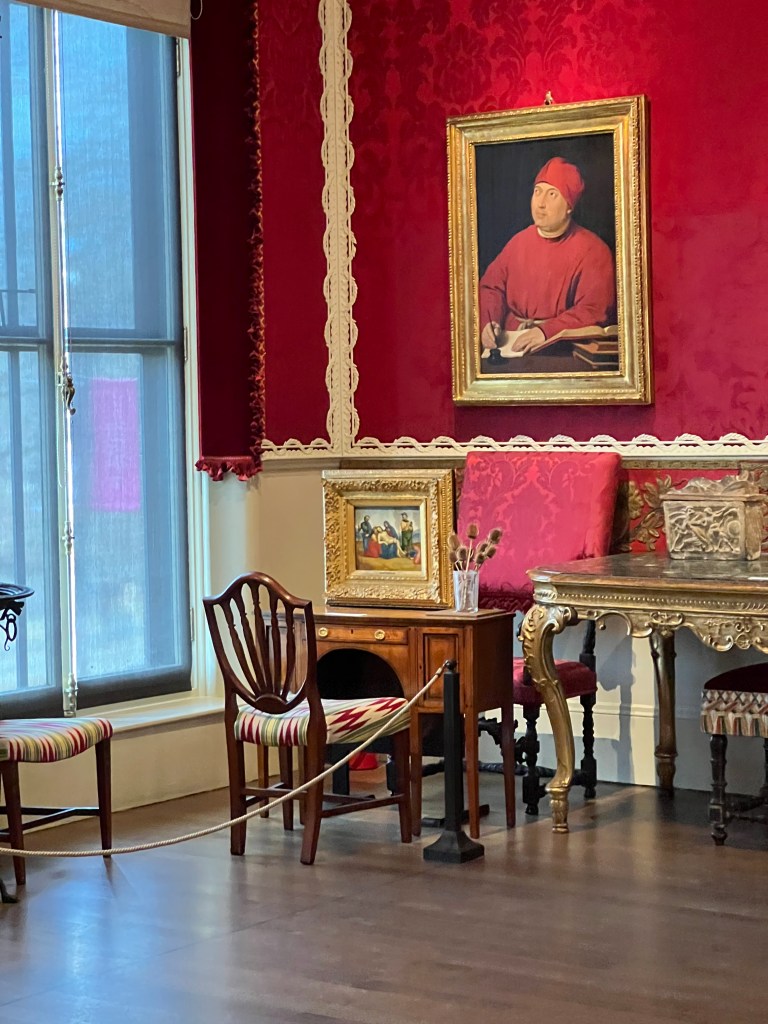
In pride of place on the left of the room are the two Raphael paintings that give the room its name. On the wall in the northeast corner is “Tammaso Inghirami”, a vivid portrait of a Cannon reflecting at his desk. It was acquired by Mrs. Gardner in 1898, the first of this High Renaissance master’s work in the United States. Just two years later, Bernhard Berenson again arranged for the purchase of a Raphael painting. That smaller and earlier work is displayed just below the portrait on a small mahogany writing desk set out from the wall so as to catch the natural light and our attention. As I scan the room from the threshold, I am drawn by design to the Raphael installation.
The eighteenth century English desk holds the painting titled “Lamentation over a Dead Christ”. It shows the grievers around the body of Christ, just after his crucifixion. One of the twelve matching chairs (there is also a coordinating chaise lounge) is set in front of this, inviting us to imagine ourselves pulling up that chair and gazing eye-to-eye with the participants of this little scene.
Art historians use established art terms, classifying subject matter in order to summarize complex concepts or stories succinctly. However, this is only useful if we understand the context. From Annunciation (the angel telling the virgin she would be the mother of God) to Assumption (when Jesus rose back into heaven after his earthly resurrection), these terms refer to episodes in the life of Christ. Each term communicates a full story, with generations of symbolism, mythology, and religiosity that, when considered, enhance the meaning and experience of the art.
A “Pieta” is a representation of Mary, the Mother of Christ, holding and mourning the body of her son after his death on the cross. There are several fifteenth century Pietas in Fenway Court, including a sketch by Michelangelo. Embedded in “Lamentation” is a Pieta. Raphael places The Virgin Mary cradling her son in the center of the scene, surrounded and attended by Nicodemus, Joseph of Arimathea, Mary Magdalene and another woman (likely representing the nuns of S. Antonio at Perugia for whom the altar painting was commissioned.)
A Madonna, derived from the Latin word for “my lady”, has come to mean an artistic representation of Mary either alone or with her child Jesus. From simplistic early depictions in the Roman catacombs intended to tell the Gospel story, through ornate and symbolic icons communicating ecclesiastic moral lessons, to more naturalistic and anatomically correct mother and child portrayals of the High Renaissance expressing human virtue – the Madonna is an enduring theme reflecting contemporary theology.
The mother of Jesus, knew through Holy revelation (an angel told her so), that her son was The Christ. The Biblical account in Luke 2:9 states “But Mary treasured up all these things and pondered them in her heart.” Living with the tension of fear and joy is part of what makes Mary holy. Besides the prophecy that he was to be the Messiah, events in Jesus’ infancy must have given his mother trepidation about his future. The Magi warned them to flee and brought sacrifice and burial spices as a gift. Simeon, in blessing the infant Jesus warns his mother that “…a sword will pierce through you own soul also…” Luke 2:35.
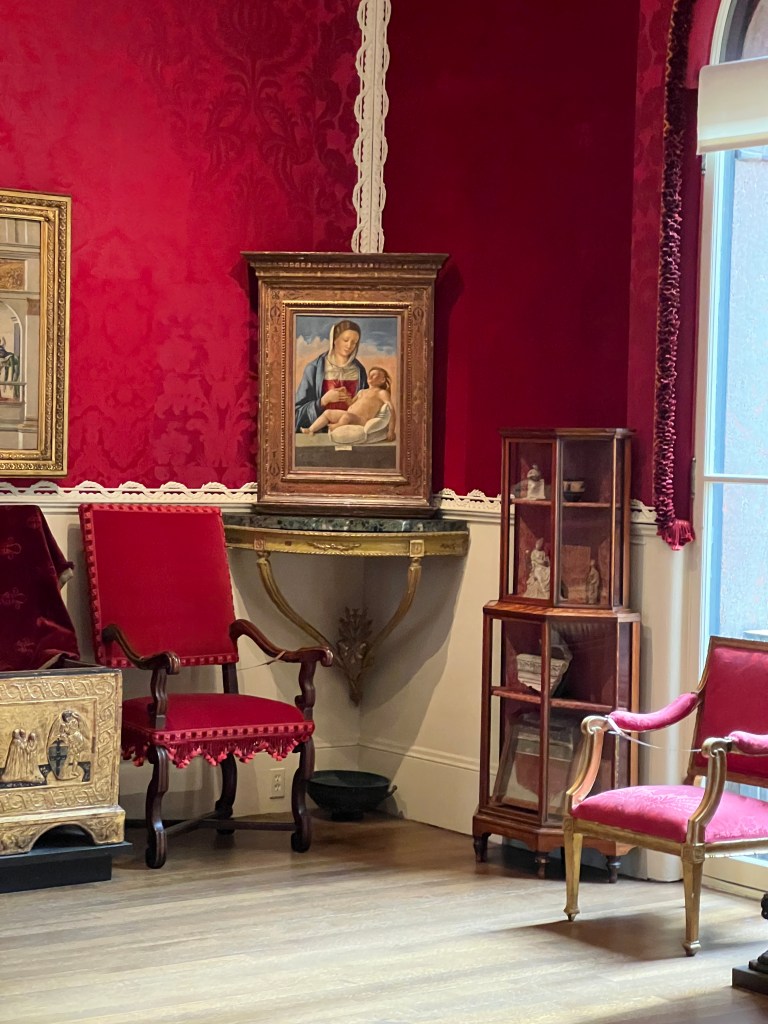
A late purchase (1921) through Bernhard Berenson, the Bellini Madonna is displayed in pride of place, tilted towards the viewer for emphasis, on a Venetian corner console bracket. The works in this room are almost all early acquisitions, most before the museums’ opening in 1903.
Given Isabella Gardner’s tragic loss of a toddler at almost two makes this specific choice of a Madonna curious. The baby is uncharacteristically asleep, limp in body, with his eyes shut; except for his coloring, he appears dead. Giovanni Bellini’s “Madonna and Child” is Bellini is a curious and unusual hybrid of subject – it is a Madonna and also a Pieta.
Both Raphael and Bellini paint their haloed Mary wearing a red dress with a blue cloak (red representing her sacrifices, her love, and blue, her holiness and royalty.) Mary’s expression is attentive, somber, mournful and wholly focused on her precious child in both portrayals. But it is the position and attitude of Jesus where these works have a deeper connection. In each, the naked supported body, the dangling arm, the closed eyes of Jesus are strikingly poignant and the center focus.
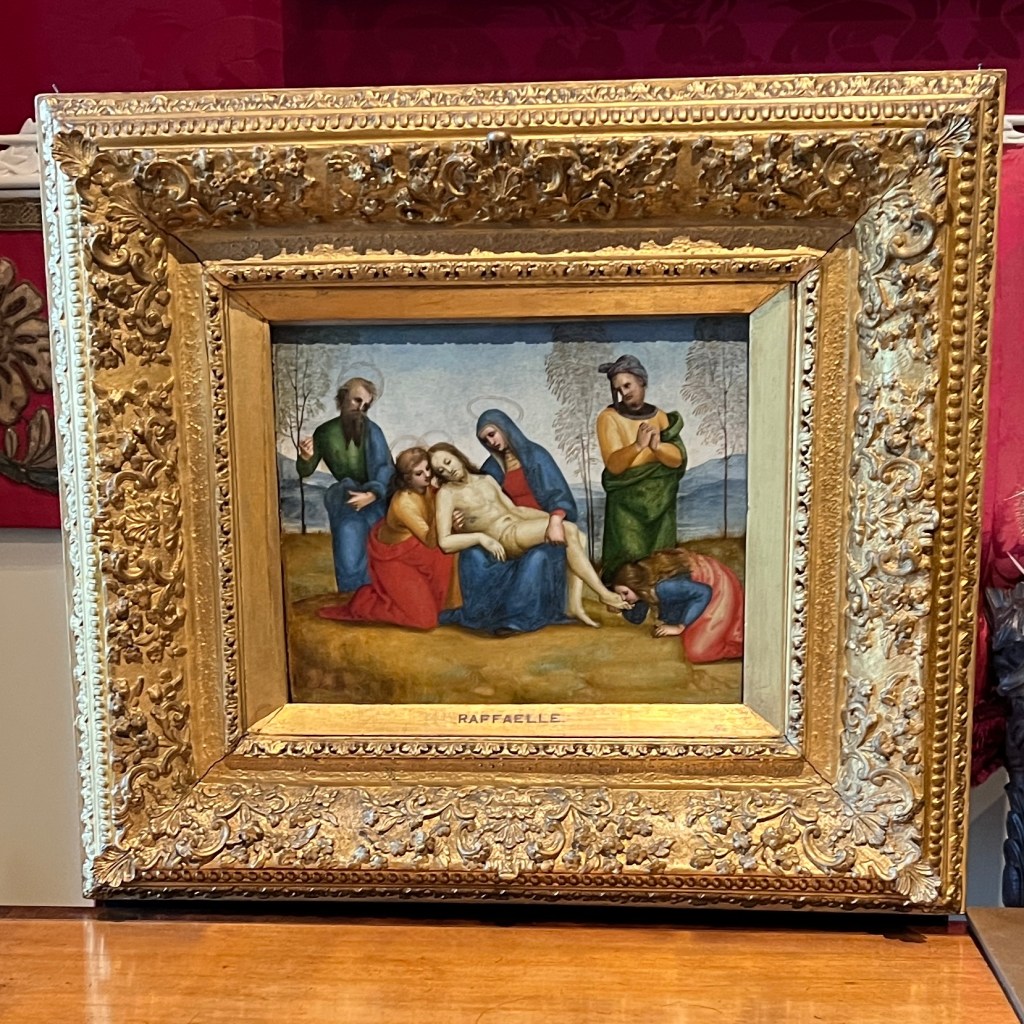
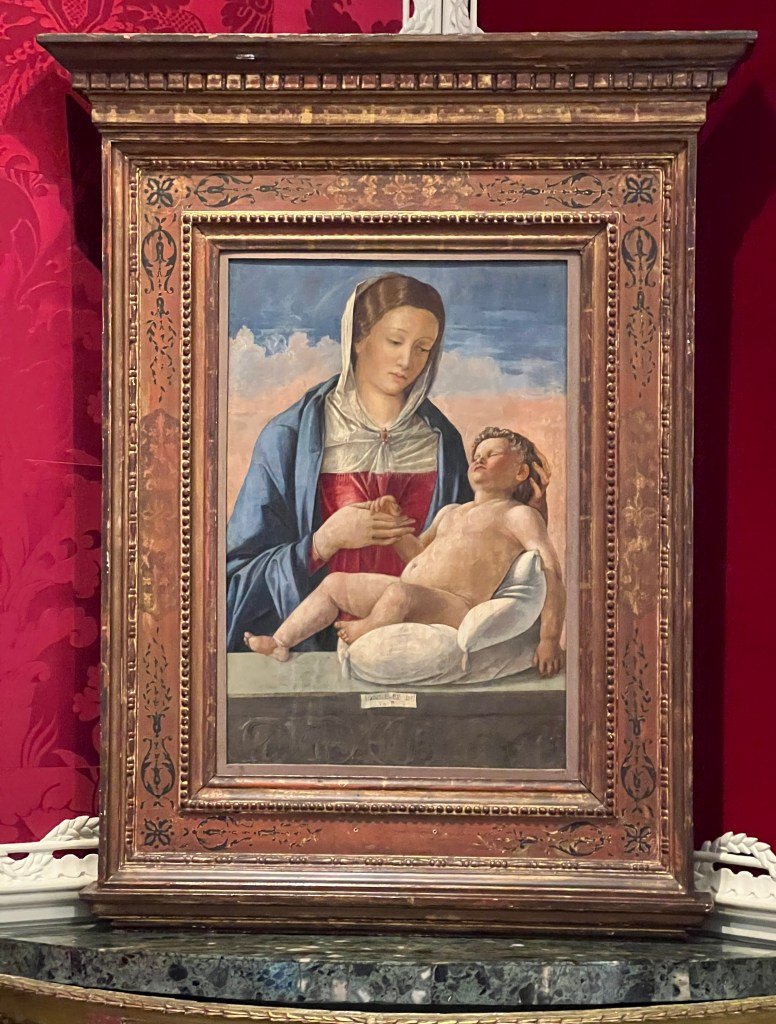
In a classic Pieta, in order to show both the Christian reality of death together with the hope that he does indeed live again, there is sometimes a visual clue as to both realities. There are veins full of life blood carved into Michelangelo’s Pieta at the Vatican.
The highlight and juxtaposition of these works suggests an intentional relationship. These paintings are connected. I believe the subject matter is testimony to a the loss of child. Isabella’s intimate experience, reflected upon over a lifetime was still being shared. The Bellini was purchased just three years before Isabella’s death when her son would have been 58 years old and his mother 81. Yet, Jackie was remembered and cherished; his story shared by his mother who continued to treasure and ponder his life throughout her own.


