That your art, as best it can, also follows Divine Intellect, as the disciple follows the master; So in reality, your art is, as it were, God’s grandchild.
– Dante Alighieri
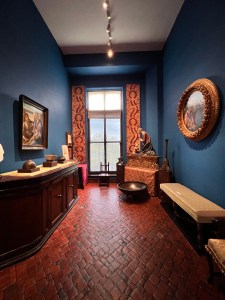
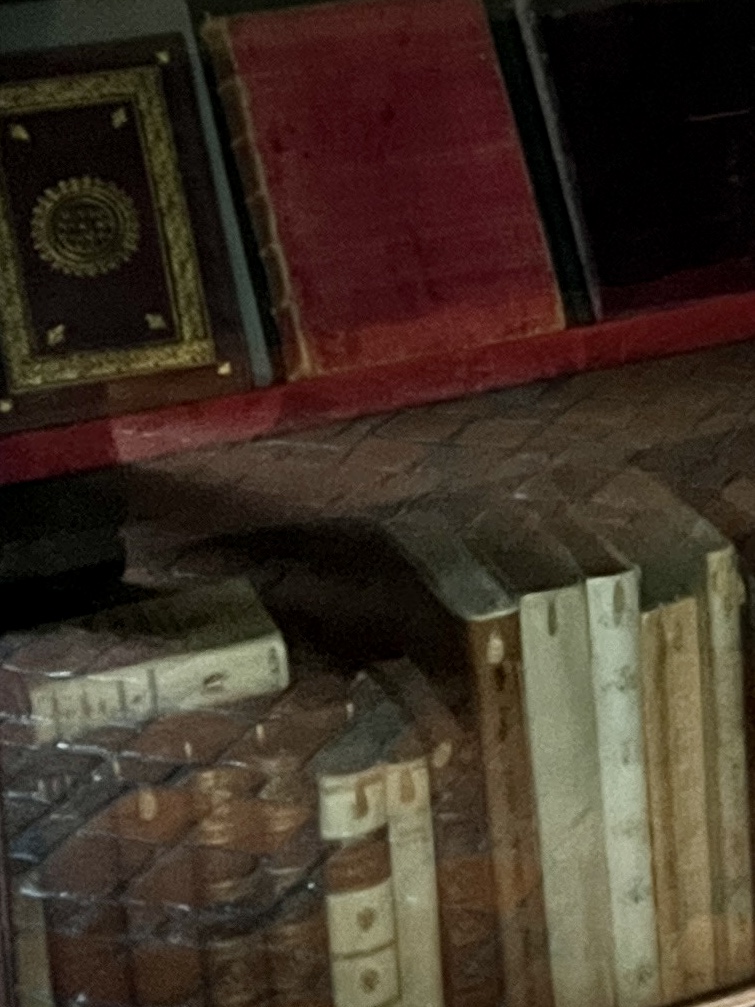
On the East side of the third floor at the ISGM is the Long Gallery which leads into the Chapel. As one enters from the Titian Room ISG curated several tableaus depicting The Holy Mother. At the Southern end is the distinctly feminine Chapel. In between these dramatic and intimate spaces are a number of cabinets and display cases showcasing some of ISG’s treasured collections. At more than 9 feet, the dark Dante Bookcase dominates the Eastern wall. Inside are several editions of Dante’s Divine Comedy, a collection of 16th-18th century Venetian manuscripts, important early Italian writing, and the correspondence pertaining to these acquisitions. A wooden altarpiece, “The Madonna and Child with Saints and Angels”, hangs above.

The writings of Dante were of particular importance to ISG. Around 1888, she joined the newly formed Dante Alighieri Society (still active in Boston), began attending lectures, and eventually acquired thirteen original copies of The Divine Comedy for academic pursuit – including one illustrated by Botticelli in 1481. Founded and led by Charles Eliot Norton, Henry Wadsworth Longfellow, and James Russell Lowell, Society members devoted themselves to studying the Dante’s writing and all things Italian.
Following the death of her only child at the age of two in 1865, Gardner had descended into a profound depression – a Dantean “dark wood” – from which she emerged knowing that her future path would not be a conventional one. Energized by the experience of beauty, she evolved from socialite and collector to artist and philosopher.
– Linda Docherty, “Translating Dante, Isabella Stewart Gardner’s Museum as Paradiso”, Religion and the Arts 22 (2018) page 195.
ISG’s enduring gift is certainly the collection and museum that she created. From personal grief, to awareness of beauty, to creation, to the selfless sharing of that collection, ISG follows Dante’s allegorical and instructive path of the pilgrim from Hell, through Purgatory, to Paradise. Paradise, according to Dante, being an elevated state of appreciation and generosity.
In Biblical Christian theology, God has no grandchildren; every individual is responsible for their relationship to the Almighty and, when Right with God, are considered His children. Therefore, as sons and daughters of God, Dante supposes that what we create, our art, is the logical, resulting “offspring”. Thus, “…art is, as it were, God’s grandchild.” The Isabella Stewart Gardner Museum is Isabella’s offering, culmination, and legacy.


 Isabella's View